
Micro Markets: A Store In Your Breakroom
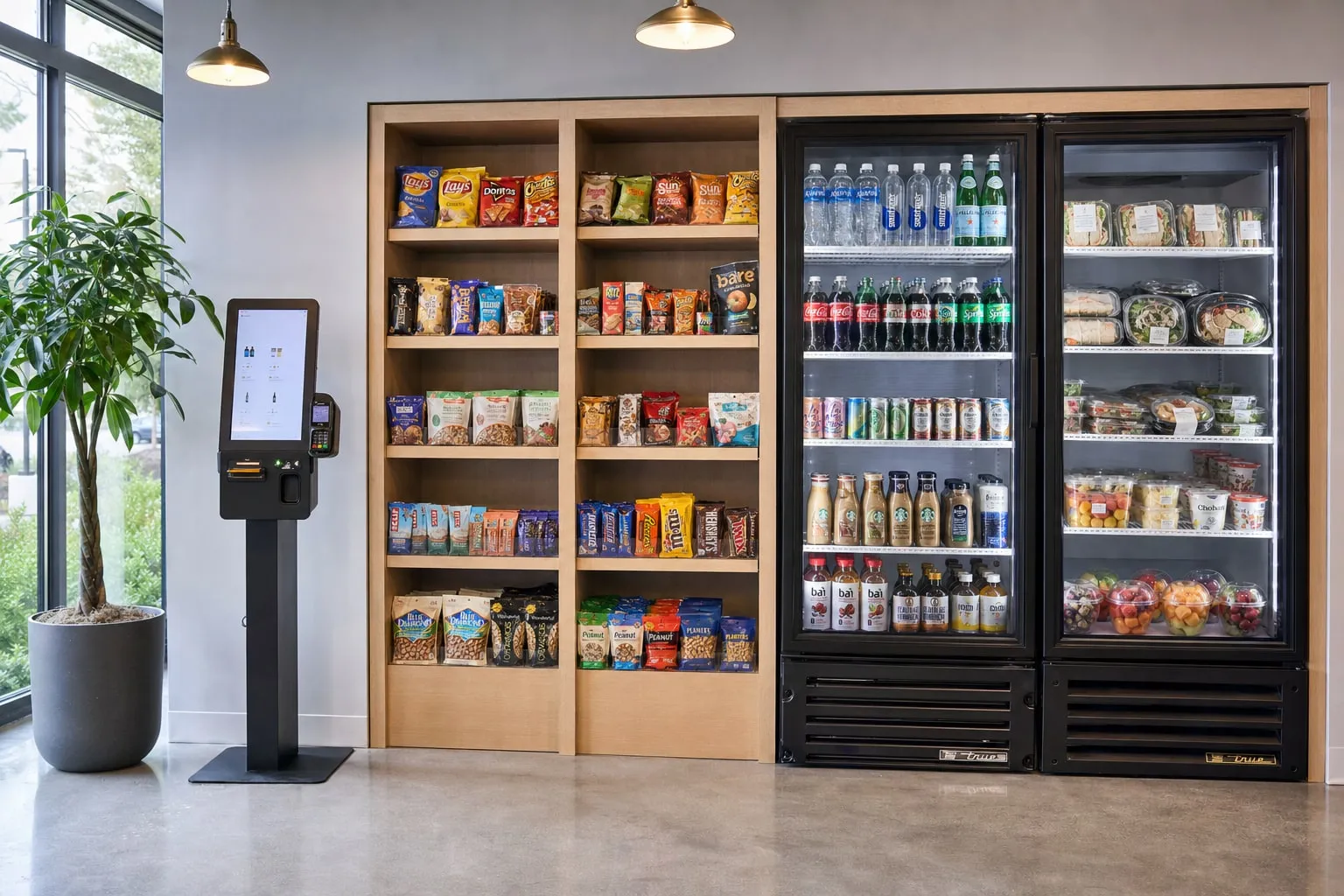
A micro market replaces the vending bank with an open, unattended mini-store — shelving, glass-door coolers and a self-checkout kiosk. Several times the variety of a machine, fresh food included, and OSO Vending builds it at no cost to your business.
What Makes a Micro Market Different
Instead of products behind glass, everything sits on open shelves and in coolers — your team picks items up, reads the label, and checks out at the kiosk with a card or phone in seconds.
- Several times the selection. 150–400+ products versus ~45 in a vending machine: fresh meals, salads, sandwiches, fruit, snacks, drinks and everyday sundries.
- Fresh food, properly merchandised. Refrigerated cases hold real lunches — the thing every breakroom survey asks for first.
- Self-checkout that just works. Scan, tap, done. No coins, no coils, no codes.
- Open 24/7. Every shift shops the same shelves; restocking follows sell-through data.
- Designed for your room. We plan the layout around your space and headcount, install it, and keep it stocked — free.
Is a Micro Market Right for Your Site?
The honest threshold: micro markets earn their keep at sites with roughly 75 or more people a day. Below that, a smart cooler — which carries much of the same fresh range in one cabinet — is usually the better call, and we will tell you so rather than overbuild. Plenty of our accounts run a cooler first and upgrade to a market as headcount grows.
Want the breakroom your team brags about?
We design, install and stock the whole market — you provide the room.
What Is a Micro Market, Exactly?
A micro market is an open, self-checkout convenience store built inside your breakroom: real shelving, glass-front coolers, sometimes a freezer, and a kiosk where people scan items and pay by tap-to-pay, Apple Pay, Google Pay, or a stored market account. There is no glass wall between customer and product. Employees pick things up, read the label, change their mind, and check out in under a minute.
Because nothing has to fit inside a spiral coil or drop into a bin, a market can carry fresh salads, wrapped sandwiches, protein boxes, yogurt, fruit, and full-size drinks a traditional machine physically cannot vend. A vending bank offers a few dozen choices; a well-run micro market offers several times that, with the mix changing week to week based on what sells.
Why Do Micro Markets Need About 75 People on Site?
Roughly seventy-five people on site is where a micro market starts making sense, and the reason is fresh food math, not greed. Coolers full of perishables only stay fresh and varied if enough people buy every day. Below that headcount, sandwiches hit their pull dates before they sell and the market hollows out into a room of chips and soda that took up half your breakroom.
Some operators will install a market anywhere and let it limp along half-stocked; we would rather tell you the truth during the site walk. At thirty to fifty people, a smart cooler delivers most of the fresh-food experience in a fraction of the footprint, and traditional snack, drink, and combo vending machines still earn their keep at smaller sites and satellite areas.
The threshold is a guide, not a law. A warehouse running around the clock with no restaurants nearby can support a market at a lower headcount than a nine-to-five office next to a food court. Traffic, shifts, and nearby options all move the line.
Designing the Market: From Site Walk to Floor Plan
Every market starts with a walkthrough of the actual room, not a template from a catalog. We measure the space, find the outlets, check clearances for delivery, and watch how people move through the breakroom, because a kiosk in a bad corner creates a line that kills lunch-rush sales. Coolers anchor the back wall where compressors can breathe, shelving runs where people browse, and the kiosk sits on the path out.
Power and connectivity get settled before install day: coolers and kiosks want dedicated circuits and a reliable connection so card payments never hang. Markets also anchor complete breakroom planning. Satellite snack and drink machines near a far dock, or a healthy vending line backing a wellness program, get planned in the same visit, so one operator handles the full layout.
How Does the Planogram Match Your Workforce?
The planogram, the map of what goes where, is built from who works in your building and when. A logistics crew on a night shift buys differently than an accounting floor. Geography matters too: inland sites in Riverside and San Bernardino counties get drink-heavy planograms because heat drives beverage sales most of the year, and multi-shift warehouses get restocking timed so the market is full when the night crew clocks in.
Healthy vending lines get real facings instead of one token row, and the sales data settles the eternal argument: people do buy them when good options sit at eye level and are priced fairly next to the chips. After launch, remote monitoring shows exactly what sells: slow movers get swapped out, strong sellers get more facings, and a few weeks of real purchases tune the planogram to your building.
Fresh food gets handled like groceries. Perishables ride in refrigeration from supplier to shelf, coolers hold safe temperatures around the clock, and every service visit includes pulling anything short-dated. Because the kiosk reports what sold overnight, ordering runs on sell-through; less waste per item is what makes variety possible.
What About Theft and Shrink?
Shrink is the honest question every facilities manager asks about an open market, and the honest answer is that it is managed, not eliminated. The population is closed and known, people shop alongside coworkers, the kiosk logs every transaction, and cameras cover the room. We watch inventory counts against kiosk sales, and if shrink creeps, the response is practical: adjust the layout, move high-value items into coolers nearer the kiosk, and loop in your site contact.
If a location truly cannot support open shelving, we say so and convert the fresh-food side to smart coolers, where the door only opens after a card or phone tap and checkout is automatic. That preserves the fresh food program while closing the loophole, and it is rarely needed.
What Does a Micro Market Cost Your Facility?
Nothing. Placement is one hundred percent free: fixtures, coolers, the kiosk, delivery, installation, restocking, and every repair are on us, with no contracts and no cancellation fees. Our revenue comes from product sales at the kiosk, so the market only works for us if it genuinely works for your people.
The facility contributes space and power: a stretch of wall, dedicated outlets, and a data connection. Compare that with staffing a cafeteria or subsidizing food delivery. Employees pay retail for what they buy, and the employer's out-of-pocket cost stays at zero. If headcount drops after a lease change, you are not locked in, and there is no fee for leaving.
What Do Off-Site Snack Runs Cost Your Team?
Drag the sliders to match your site. The math: people × runs × minutes, priced at a loaded labor rate — the quiet cost an on-site machine removes.
An OSO machine or smart cooler costs your business $0 — the payback is entirely in time kept on site. Get one placed free →
Where Micro Markets Earn Their Keep in Southern California
Multi-shift logistics buildings in the Inland Empire are the classic site. The corridor through Ontario, Fontana, Rancho Cucamonga, and Moreno Valley runs some of the busiest warehouse floors in the country, staffed around the clock, far from anything open at three in the morning.
Office parks and campuses across Los Angeles and Orange County are the other natural fit; we already run a combo machine on the Westcliff University campus in the Irvine area. San Diego County rounds out the route map, from lab campuses to distribution sites along the interstate corridors, with routes covering Los Angeles, Orange, Riverside, San Bernardino, and San Diego counties.
After install, you deal with the person who owns the outcome. OSO Vending is locally owned and operated, Brett runs the routes himself, and nothing is subcontracted. Service problems get a technician the same day in most cases, within twenty-four hours at the latest; kiosk refunds go out via Zelle, usually the same day; and every machine and kiosk carries a QR sticker linking to our feedback page. So Cal Based. Local Proud. is the operating model.
Getting started takes one conversation. Call or text (909) 500-3241 with your headcount, shifts, and rough space; a walkthrough takes about half an hour and commits you to nothing. If a micro market is the right fit, we will design it; if not, we will say so and suggest the format that is.
Micro Market Questions
What is a micro market?
A micro market is an unattended, open shelf-and-cooler store inside your breakroom, with a self-checkout kiosk instead of a machine front. It carries several times the variety of a vending machine — fresh food, salads, sandwiches, full-size drinks, snacks and sundries — and works best at locations with roughly 75 or more people on site. OSO Vending designs, installs and restocks micro markets across Southern California at no cost to the host business.
Get a Free Micro Market Assessment
A real person — the owner, not a call center — will get back to you within one business day. No spam, no pressure, and we never sell your info. Prefer to talk? Call or text (909) 500-3241.